If you're looking at affordable new launches in Dubai right now, two names keep coming up: Downtown Jebel Ali and Dubai South. Both sit in the southwest of the city, both are cheaper than the Marina or Downtown, and both get sold with a big airport story attached. So buyers assume they're the same bet. They aren't. One is a play on today's connectivity. The other is a longer play on a future airport city. Here's how I'd think about the choice.
The short answer
Pick Downtown Jebel Ali if you want existing road and metro access along Sheikh Zayed Road and a shorter path to renting. Pick Dubai South if you're comfortable holding for longer and you're betting on the Al Maktoum airport expansion and the wider Expo City area to drive demand over the next decade. Both can work. They just reward different kinds of patience.
| Downtown Jebel Ali | Dubai South | |
|---|---|---|
| Main road | Sheikh Zayed Road (E11) | Sheikh Mohammed bin Zayed Road (E311) and Emirates Road |
| Metro | Red Line stations along the corridor | Route 2020 reaches Expo City; residential areas mostly car-based today |
| Main demand driver | Jebel Ali business corridor, JAFZA, Dubai Investment Park, Palm Jebel Ali | Al Maktoum International Airport, logistics, Expo City |
| Time horizon | Shorter | Longer |
| Main risk | New supply competing for the same tenants | Airport and community timelines slipping |
Downtown Jebel Ali: what you're buying
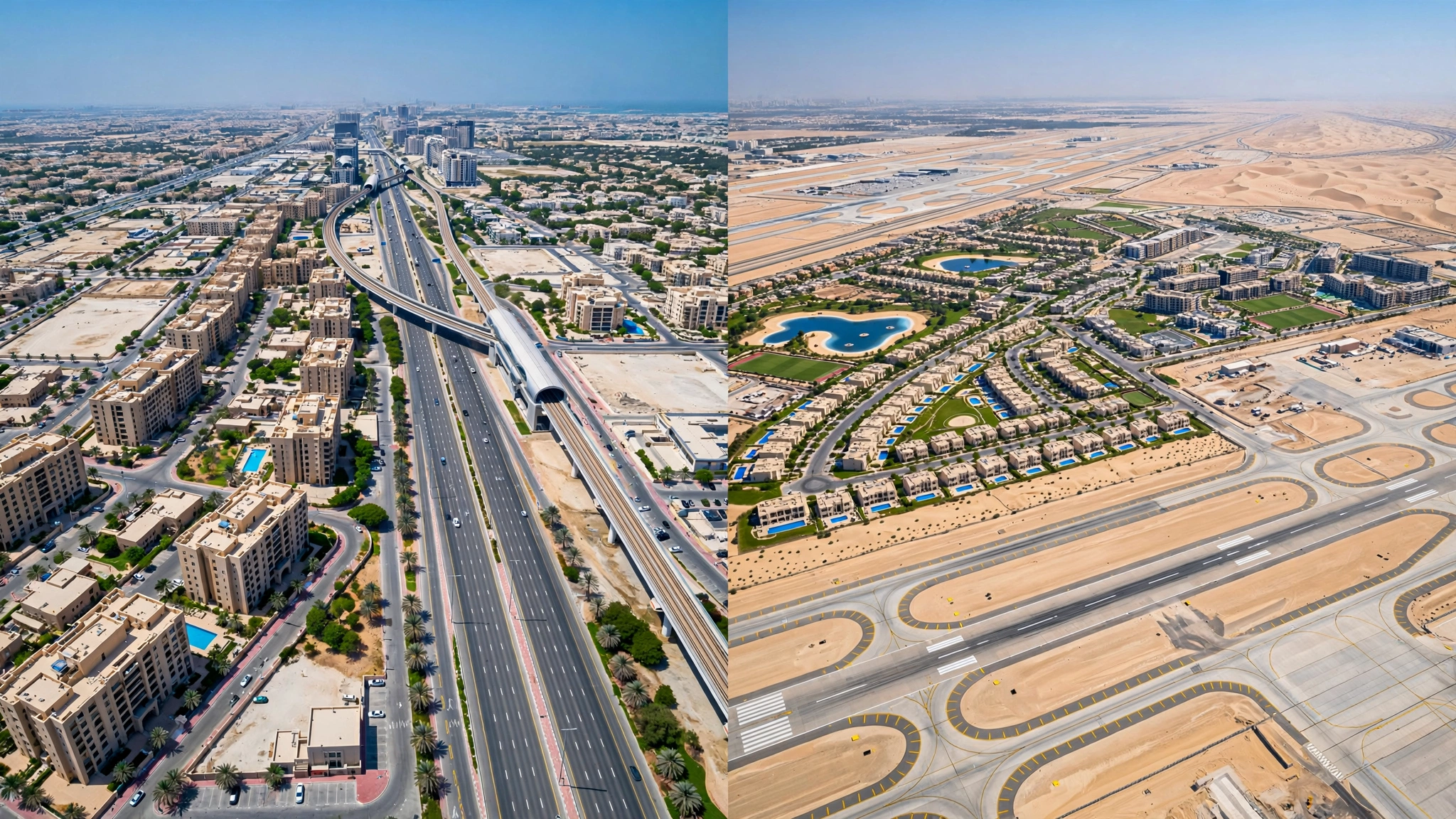
Downtown Jebel Ali sits right on Sheikh Zayed Road, between Ibn Battuta and the Jebel Ali free zone. That's its whole case. The Red Line runs along this stretch, the drive to Dubai Marina and JLT is short, and you're close to the big employment hubs: the Jebel Ali Free Zone, Dubai Investment Park and the Expo area. On the other side, Nakheel's Palm Jebel Ali is under development, which should lift the profile of the whole corridor over time.
For a rental investor, that existing connectivity matters. Tenants who work in JAFZA or along Sheikh Zayed Road can commute easily today, not in 2030. The catch is that developers know this too, and a lot of new projects are launching here. When several towers hand over around the same time, they compete for the same tenants. So the specific building, its layout and its service charges matter more than the area name.
Prices here have climbed. Gulf News reported in mid 2025 that launches in the area started from around AED 800 per square foot, with averages nearer AED 1,400. Treat those as a snapshot, since launch pricing moves fast, and check current DLD transactions before you compare.
Dubai South: what you're buying
Dubai South is a huge government-backed master development around Al Maktoum International Airport (DWC). The story is the airport. In April 2024, Dubai announced an AED 128 billion plan to expand DWC into the world's largest airport, with a stated capacity of 260 million passengers a year, five parallel runways, and the intention to move all of DXB's operations there over roughly the next decade. If that happens on schedule, the area around it changes completely: jobs, hotels, logistics, and a lot of people needing homes.
Today, though, much of Dubai South is still being built out. Expo City next door is up and running with a metro link, but many residential pockets rely on cars, and community facilities are still filling in. Prices are generally lower than closer-in areas, which is exactly the appeal. You're buying earlier in the story.
The honest part: a 10-year airport plan is a 10-year airport plan. Megaprojects slip, phases get resequenced, and the full benefit may take longer than the brochure suggests. If you buy in Dubai South, buy something that makes sense on today's rent, and treat the airport as upside, not the whole reason.
Rent and resale: who's the tenant?
In Downtown Jebel Ali, your likely tenant works along the Sheikh Zayed Road corridor or in the free zone and wants a short commute. Smaller units, studios and one-bedrooms, tend to suit them. In Dubai South, today's tenants are often linked to aviation, logistics and Expo City, plus families looking for more space for the money. That base should grow as the airport grows, but in the meantime expect more competition from new handovers and a slower rental ramp-up in newer communities.
For resale, Downtown Jebel Ali's connectivity is easy to explain to the next buyer. Dubai South's resale story depends more on how visible the airport progress is when you sell. Our rental yields guide helps you model both honestly.
The supply question
Both areas are full of off-plan launches, and Dubai as a whole has a heavy pipeline, with Betterhomes estimating around 74,100 homes completing in 2026 and about 160,700 in 2027, mostly apartments. That doesn't rule either area out. It just means you should check how many similar units are completing within a kilometre of yours, and buy something that stands out on layout, price or quality. Our Dubai prices article covers the bigger picture.
Who should choose which
Choose Downtown Jebel Ali if you want rental income sooner, value metro and Sheikh Zayed Road access, and prefer a market where tenants already exist.
Choose Dubai South if you have a longer horizon, want a lower entry price, are comfortable with infrastructure timing risk, or want more space for a family budget.
Be careful in either if your plan depends on a quick flip or on reselling before handover.
SAMANA projects in and around these areas
SAMANA Portside is in Downtown Jebel Ali on Sheikh Zayed Road, with convertible one and two-bedroom layouts. On the Dubai South side, SAMANA Hills South 3 is a Dubai South option, and SAMANA South Haven sits in Dubai Industrial City in the same southern corridor. Confirm the exact location, handover date and payment plan for each on the project page, and check the developer side with our developer comparison guide.
My take
If I had to put a cautious investor's money into one of them today, I'd lean Downtown Jebel Ali for the existing metro and corridor demand, and I'd be fussy about the specific building. If you're younger, patient and buying for the long haul, Dubai South can make sense at a lower entry, as long as the numbers work without the airport doing all the heavy lifting. Either way, don't buy the story. Buy the unit.
Want a side-by-side on specific units in both areas? Message the Saiban Associates team on WhatsApp.