
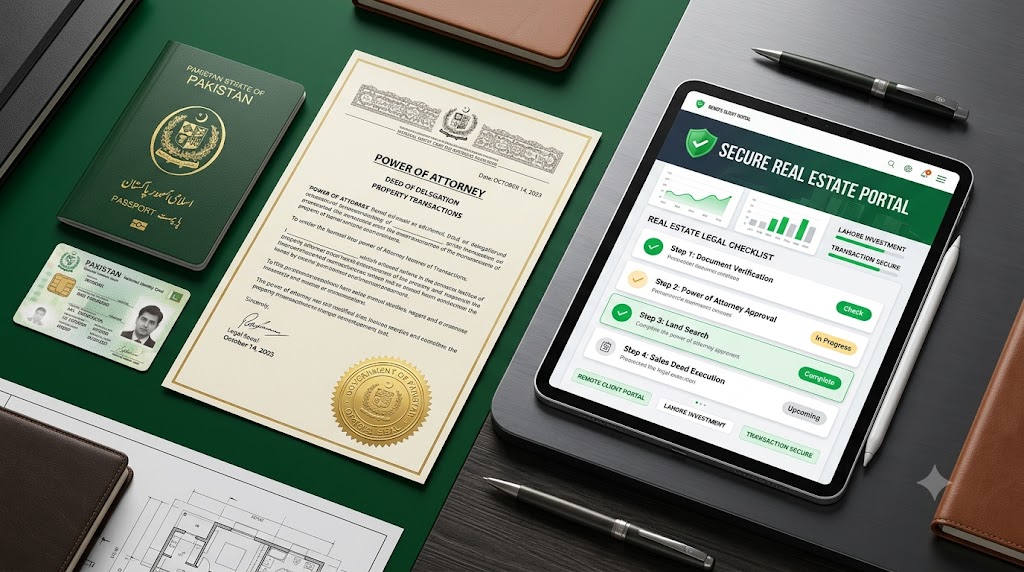
Short answer: you need a valid NICOP, a Special Power of Attorney attested through your consulate or processed via NADRA's online portal, and every payment moving through a documented banking channel. That's it. The complications come from mismatched details and from choosing the wrong type of POA, and both are avoidable.
What's in this guide
- Your NICOP, and the detail that stops transfers
- Power of Attorney: the choice that matters
- Doing the POA online from the Gulf
- What to have ready
- Moving the money
- Frequently asked questions
A client in Sharjah lost four months on a plot transfer because his father's name was spelled one way on his NICOP and another way on his passport. One letter. Everything else was in order, the money was ready, the seller was waiting.
That's what actually goes wrong with remote purchases. Not dramatic fraud. Paperwork that doesn't line up.
So here's what you need, in the order you'll need it.
Your NICOP, and the Detail That Stops Transfers
Your NICOP is the identity document Pakistani authorities work from when you're not resident. Without a current one, nothing moves.
Getting it isn't the hard part. Making it agree with your other documents is.
Before you start anything, sit down with your NICOP, your Pakistani passport, and your Emirates ID or Iqama side by side. Check the spelling of your name. Check your father's name. Check your date of birth. Check the passport number on your NICOP against the passport you actually hold now.
Any mismatch, however small, and you'll be stopped at biometric verification or at the No Demand Certificate stage. Fixing it from abroad takes weeks. Catching it now takes ten minutes.
The other thing people forget: an expired NICOP is simply rejected. Not queried, rejected. Update it through the NADRA portal before you start looking at plots, not after you've paid a token.
Power of Attorney: The Choice That Matters
If you can't fly back to sign, someone in Pakistan has to sign for you. A Power of Attorney is what gives them that right.
There are two kinds, and this is the decision people get wrong.
| General POA | Special POA | |
|---|---|---|
| Covers | All your affairs in Pakistan | One named transaction |
| Expires | When you revoke it | When the task is done |
| Risk to you | High if trust breaks | Limited to that plot |
Use a Special POA. Name the exact plot, the exact block, the exact society, and the exact thing your representative is allowed to do.
I know that feels like you're insulting your brother or your uncle. You aren't. Families fall out. Circumstances change. People get pressured by other people. A Special POA protects the relationship as much as it protects the plot, because it takes the question of trust off the table entirely.
Doing the POA Online From the Gulf
You used to take a day off work and queue outside the consulate in Jeddah or the mission in Abu Dhabi. NADRA's online POA portal has largely replaced that, and it works from your laptop.
Broadly, the process runs like this. You create an account and upload your drafted POA text with the property details filled in. You upload fingerprint scans for yourself and two witnesses. You pay the fee by card. Then a consular officer from your mission schedules a video interview to verify you and witness your consent.
Two things worth knowing before you start.
Your two witnesses have to be overseas Pakistanis with valid NICOPs, living where you live. Not family back home. People assume the opposite and get stuck.
And the exact steps and fees do change. Check the current requirements on NADRA's own portal rather than relying on any guide, including this one, before you begin.
What to Have Ready
Put all of this in one folder before you contact anyone:
- Your NICOP and passport data page, scanned clearly
- CNIC or NICOP copies for your two overseas witnesses
- CNIC copy of your representative in Pakistan
- Recent passport photographs against a plain white background
- The system-generated receipt once your POA is authorised
Scan properly. Phone photos taken at an angle get rejected and you'll do it twice.
Moving the Money
This part is simpler than people think, and more important than they realise.
Use a Roshan Digital Account or a formal bank to bank transfer. Not a friend who's going to Lahore next week. Not an exchange shop with a good rate. Not cash handed to someone's relative.
Two reasons. FBR cross-checks banking records against property transactions, and an untraceable payment creates a problem years later when you try to sell. And if anything goes wrong, a documented transfer is evidence. An informal one is your word against theirs.
The rate you save going informal is never worth what it costs you later.
The Part Paperwork Doesn't Cover
Getting your documents right protects you from delays. It doesn't protect you from buying the wrong thing.
You still need to verify that the society and the specific phase are actually approved, because approval works phase by phase and a good brand tells you nothing about its newest extension. That check is free and takes ten minutes on the LDA portal, and we've written the full walkthrough here.
You also need someone verifying ownership, outstanding dues and the file itself. Not the seller. Not the relative doing you a favour, however honest they are, because catching a forged transfer letter is a skill rather than a matter of goodwill.
That's the part our overseas desk handles every week for clients across the Gulf. Document verification, coordination with your family in Pakistan, and nothing moving until you've seen proof rather than heard a promise. If you're still deciding where to buy, our DHA phase comparison and the daily file rates page are the two things most overseas buyers start with.
Frequently Asked Questions
Can I get a Power of Attorney entirely online from Dubai or Riyadh?
Yes. NADRA's online POA portal lets you draft, pay for and verify a Power of Attorney through a video interview with a consular officer, without visiting the embassy in person. Requirements and fees change, so confirm the current process on NADRA's portal before you start.
Do my POA witnesses need to be in Pakistan?
No, and this catches most people out. For an online POA processed from abroad, both witnesses must be overseas Pakistanis with valid NICOPs, based where you are. Their details are verified as part of your application.
Should I use a General or Special Power of Attorney for buying property?
A Special POA, without exception. It limits your representative to the one transaction you name and expires automatically once it's done. A General POA hands over authority across all your affairs in Pakistan and stays live until you revoke it, which is far more exposure than a single plot purchase needs.
What happens if my name is spelled differently on my NICOP and passport?
The transaction stops, usually at biometric verification or when applying for the No Demand Certificate. Even a single letter is enough. Check your NICOP, passport and Gulf residency documents against each other before you start, because correcting a mismatch from abroad takes weeks.
Can I send money for a property purchase through an exchange or a friend travelling home?
You can, but don't. FBR cross-references banking records against property transactions, and an undocumented payment becomes a problem when you eventually sell. Use a Roshan Digital Account or a formal bank transfer so there's a clean, traceable record tied to the purchase.
How does Saiban Associates help buyers based in the UAE or Saudi Arabia?
We verify the file, the approval status and the seller's ownership independently before any money moves, coordinate with whoever is acting for you in Pakistan, and handle the transfer process at the registry. The paperwork above is something you can do yourself. What's genuinely hard from four thousand kilometres away is knowing whether what you're being told matches what's on the ground, and that's the part we cover.