Somebody posted this on r/dubairealestate last week and the replies were exactly what you'd expect. Marina for the lifestyle. Business Bay for the professionals. Dubai Hills for families. Dubai South because, you know, growth. Four communities, four one line reasons, zero numbers. Here's the thing nobody in that thread mentioned: AED 2 million isn't a random budget. It's the Golden Visa line. And once you know that, the question stops being "which area is nice" and becomes something much more specific.
Why AED 2 million is the number people keep landing on
The UAE's 10 year Golden Visa through property requires a minimum total property value of AED 2 million. Not AED 1.9 million. Two. That threshold survived the 2026 reforms even as other rules loosened around it, and it's the reason this exact figure shows up in every forum thread, every WhatsApp group, every conversation I have with a client in Lahore or Riyadh who's been reading about Dubai for six months.
A couple of things about that rule that people get wrong. First, you don't need one property worth AED 2 million. You can combine units. Two apartments at a million each work the same as one at two million, and there's no cap on how many you stack. Second, off plan counts. Purchases from RERA registered developers qualify using the Oqood, which is the initial sale contract registered with the Dubai Land Department. That matters enormously in a market where off plan made up 67.3% of all Dubai transactions in Q1 2026.
Third, and this is the update most people haven't caught up on: in February 2026 the AED 1 million minimum down payment requirement was scrapped. Eligibility now rests on total property value alone. Mortgaged property is acceptable. So the old advice that you needed a million in cash sitting in a UAE account is out of date, and if someone is still telling you that, ask what else they haven't updated.
One caveat before you build a plan around any of this. Visa rules move. Verify the current criteria against the Dubai Land Department portal or GDRFA before you sign anything, not after.
The four areas from that Reddit thread, checked against actual yield data
Vibes are not a strategy. So let's put numbers on the four communities that thread mentioned.
Dubai Marina averages roughly 7% gross rental yield. It's liquid, it's got a deep tenant pool, and you can sell it in a downturn because somebody always wants Marina. Business Bay sits around 6.5%, with a professional tenant base and strong resale. Dubai Hills Estate is the family play, and family communities in Dubai consistently trade yield for capital growth: villa yields across established communities run about 4.5% to 6% gross, while villa values have appreciated far harder than apartments since 2021. Dubai South, which the poster flagged as "gaining attention," is actually the yield leader of the four at around 8.1%.
For context, the top of the yield table isn't any of those. Jumeirah Village Circle runs 8.5% or higher. International City sits near 8.9%. Dubai Silicon Oasis around 8.5%. These are the unglamorous ones. Nobody posts a photo of International City on Instagram. They just quietly out earn the postcard areas by two to four percentage points a year.
The gross versus net trap
Here's where most first time investors lose money on paper before they lose it in reality. Every yield figure quoted above is gross: annual rent divided by purchase price. Net yield, which is what actually lands in your account, typically sits 1.5% to 2% below gross once you account for service charges, maintenance, vacancy, and management.
Service charges vary more than people expect. Around AED 12 per square foot in mid market communities, up to AED 35 per square foot in premium towers. On a 1,000 square foot apartment that's a swing of AED 23,000 a year, every year, forever. On a Downtown or Sheikh Zayed Road tower running AED 20 to 28 per square foot, that single line item can eat two full percentage points of your return.
Then vacancy. A realistic void assumption is 5% to 8% of annual rent for a Marina or Downtown unit, and 8% to 12% for a JVC apartment where tenants turn over faster. Underwriting at 100% occupancy is how you end up disappointed in year two. And if you're financing, non resident mortgages in 2026 have been priced around 6.5% to 8.5%. Do the arithmetic on that against a 7% gross yield before you get excited about leverage.
Yield or appreciation. You don't get both
This is the actual decision, and the Reddit poster half asked it at the end without realising it was the whole question.
If you want cash flow, you buy where the entry price is low relative to rent. That means the affordable, high demand communities: JVC, International City, Dubai South, Silicon Oasis, Dubailand. Ugly on a brochure, excellent on a spreadsheet.
If you want capital appreciation, you buy where supply is constrained and demand is structural. Mature prime communities like Downtown, Palm, and Dubai Hills have averaged roughly 6% to 10% annual appreciation across the 2022 to 2026 cycle, with real volatility around that average. Mid market apartments in newer communities have been more variable, in the 4% to 8% range, with deeper drawdowns wherever supply arrived faster than tenants did.
My honest view after years of watching Pakistani clients buy into this market: most people say appreciation and behave like they want yield. They tell me they're in it for ten years, then get anxious in month eight when the unit sits empty. If that's you, buy for cash flow. Rent covering your instalments is the thing that lets you actually hold long enough for the appreciation story to play out.
The downside nobody in that thread mentioned
Supply. Dubai's delivery pipeline is enormous right now: roughly 146,400 units expected in 2027 and another 120,100 in 2028. Business Bay, JVC, Dubai South, Dubai Science Park, and Dubai Hills Estate together account for more than a third of 2026 deliveries alone.
Read that again alongside the fact that most off plan projects selling today hand over in exactly 2027 and 2028. You could be collecting keys in the same quarter as ten thousand other landlords in your submarket, all listing at once. Delivery slippage will smooth some of it, it always does. But if a broker tells you rents in a specific community will keep climbing through 2028 without mentioning the pipeline, that broker is selling, not advising.
What actually protects you here is picking a submarket where the pipeline is thinner than the demand, and buying on a payment plan that doesn't force you to sell into a soft quarter. Not glamorous advice. It's the advice that works.
So what would I actually do with AED 2 million?
Three approaches, depending on who you are.
If the visa is the point: split it. Two units around AED 1 million each, in two different submarkets, both off plan from a RERA registered developer so the Oqood does the work. You hit the threshold, you diversify your vacancy risk across two communities instead of one, and you have the option to sell one later without losing residency if the other still clears the bar. I prefer this to one AED 2 million unit for almost everyone.
If you want income above all: stay in the affordable high yield belt and don't get sentimental about the address. A studio and a one bedroom in a growing Dubailand or International City community will out earn a single Marina unit at the same total spend, and you'll rent them faster.
If you want a home you might one day use: then honestly, some of the yield math stops applying and you should buy where you'd actually want to live. Just don't tell yourself it's an investment decision when it's a lifestyle one. Both are fine. Confusing them is what causes regret.
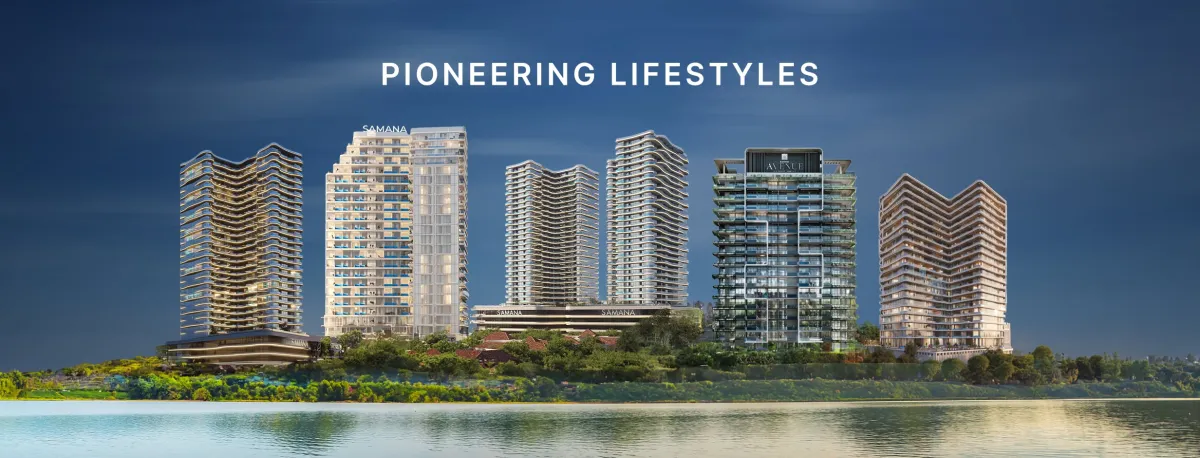
For Pakistani investors specifically, the off plan payment plan structure is usually what makes Dubai workable at all. Take SAMANA Ibiza in Dubai Land Residence Complex as a concrete example: studios from AED 699,000, one bedrooms from AED 1,049,000, two bedrooms from AED 1,489,000, on an eight year plan starting at 20% booking with the balance spread across construction and 48 months post handover. Handover is Q1 2028, and the site sits between Emirates Road and Al Ain Road, in line to benefit from the planned Blue Line metro extension. Two of those studios, or a studio plus a one bedroom, and you're at the Golden Visa threshold on instalments rather than a lump sum.
Same logic applies to nearby DLRC and Dubailand stock. SAMANA Park Meadows hands over Q1 2028 in the same corridor [confirm current starting price from project page], and Greenfield by Samana sits over in the Al Warsan and International City 2 area from around AED 850,000, with handover reported variously as Q4 2028 and Q1 2029, so confirm the date on the SPA rather than a listing site. The team at Saiban Associates handles the DLD registration and documentation end of these purchases directly from Pakistan, which removes the single biggest practical headache for a buyer who can't fly out for every signature.
A word on the Dubailand corridor, since that's where the value is right now
Dubai Land Residence Complex and the wider Wadi Al Safa area sit in an awkward spot reputationally. It's not Marina. It doesn't photograph like Downtown. Ask a Dubai resident about DLRC and you'll get a shrug.
But look at what's actually true about the location. It sits between Emirates Road and Al Ain Road, which are the two arteries that matter for anyone commuting outward rather than into Downtown. Dubai International Airport is roughly 20 to 25 minutes by car. Zayed University, GEMS schools, IMG Worlds of Adventure and Global Village are all inside a fifteen minute radius. Entry prices start under AED 750,000 for a studio, which is a fraction of what the same square footage costs in the postcard communities.
The thing that changes the maths here is the planned Blue Line metro extension. Rail access has historically been the single biggest rerating event for a Dubai submarket, because it converts a car dependent area into one that a tenant without a car will consider. If that line lands on schedule, the rental pool for DLRC widens considerably. If it slips, and Dubai infrastructure timelines do slip, you're holding a well priced apartment in a car dependent area for a few more years. That's the trade, stated plainly.
I'd rather buy at AED 700,000 in a submarket with a credible catalyst than at AED 1.6 million in one where the catalyst already happened and is fully priced in. That's a preference, not a law. If liquidity matters more to you than entry price, Marina is genuinely the safer asset, and I'd say so to your face.
Buying from Pakistan or the Gulf: what changes
If you're reading this from Lahore, Karachi, Riyadh, or Doha, your problem isn't picking a community. It's everything around the purchase.
The good news first. Dubai freehold is open to all nationalities, there's no capital gains tax, and no tax on rental income. You don't need residency to buy. The DLD registration process is genuinely well documented compared to most markets in the region.
The friction is elsewhere. Getting funds out of Pakistan for an overseas property purchase means working through proper banking channels and keeping a clean paper trail, because you will need to explain the source of funds at the Dubai end. Exchange rate timing on a multi year instalment plan is a real cost that nobody prices in at booking. And you're signing an SPA for an asset you may not have physically stood inside.
The part I'd push back on hardest: do not rely on a WhatsApp forward for the payment plan. Off plan payment structures change between launch phases, and I've watched buyers commit to a plan that had already been revised twice. Get the current SPA terms in writing from a DLD registered channel, and check the developer's escrow account number against the DLD listing before a single dirham moves. This is exactly the verification work Saiban Associates does on behalf of clients who are buying remotely, and it costs you nothing to insist on it.
What I'd do next if I were you
Before you shortlist a single project, answer three questions on paper. What is this money for: residency, income, or growth? What's your actual holding period, honestly, not aspirationally? And can you keep paying instalments if your income changes for a year?
Once those are answered, the shortlist writes itself. Residency plus income points you at two mid priced off plan units in high yield submarkets. Growth with a long horizon points you at fewer, better located assets and a tolerance for empty months. There is no single best area in Dubai, which is why that Reddit thread produced four confident answers that all contradicted each other. They were all right for different people.
And if you want the numbers checked against your specific budget, timeline, and which country your money is sitting in right now, that's a twenty minute conversation, not a research project. Get in touch with Saiban Associates and we'll run the numbers with you.
Frequently Asked Questions
Does AED 2 million in off plan property qualify for the Dubai Golden Visa?
Yes, off plan purchases from RERA registered developers count toward the threshold, using the Oqood registered with the Dubai Land Department as proof of ownership. You can also combine multiple properties to reach AED 2 million, and there's no limit on how many. Rules do get revised, so confirm current criteria with the DLD or GDRFA before you commit.
Which Dubai area gives the highest rental yield?
On gross yield, the leaders in 2026 have been International City at roughly 8.9%, JVC around 8.5%, Dubai Silicon Oasis near 8.5%, and Dubai South around 8.1%. Premium areas like Palm Jumeirah and Downtown sit lower, often 4.5% to 6%, because prices have risen faster than rents. Remember that net yield usually runs 1.5% to 2% below these gross figures.
Can a Pakistani citizen buy property in Dubai without residency?
Yes. Dubai freehold zones are open to all nationalities and you don't need a UAE residency visa to purchase. What you do need is a valid passport, funds moved through documented banking channels, and correct DLD registration. Saiban Associates handles the full documentation and DLD registration process for Pakistan based buyers, so you don't need to fly out for every stage of the transaction.
Is 2026 a good time to buy Dubai property, or is the market peaking?
It depends entirely on your holding period. The near term risk is real: roughly 146,400 units are expected to deliver in 2027 and 120,100 in 2028, which will put pressure on rents in the most oversupplied submarkets. If you're buying to flip inside two years, that pipeline is your problem. If you're holding seven to ten years on a payment plan your income comfortably covers, the supply wave matters much less.
How much should I budget beyond the purchase price?
Plan for the 4% DLD transfer fee, an administration fee, agency fees where applicable, and then ongoing service charges of roughly AED 12 to AED 35 per square foot per year depending on the tier of building. Also budget for vacancy, realistically 5% to 12% of annual rent depending on the community. A yield calculation that ignores these isn't a yield calculation.
Is it better to buy one AED 2 million apartment or two smaller ones?
For most investors chasing both the Golden Visa and rental income, two units in different submarkets is the stronger play. You spread vacancy risk, smaller units usually rent faster, and you keep the option to sell one later. The exception is if you actually intend to live in it, in which case one property you'd genuinely want to occupy beats two you wouldn't.