
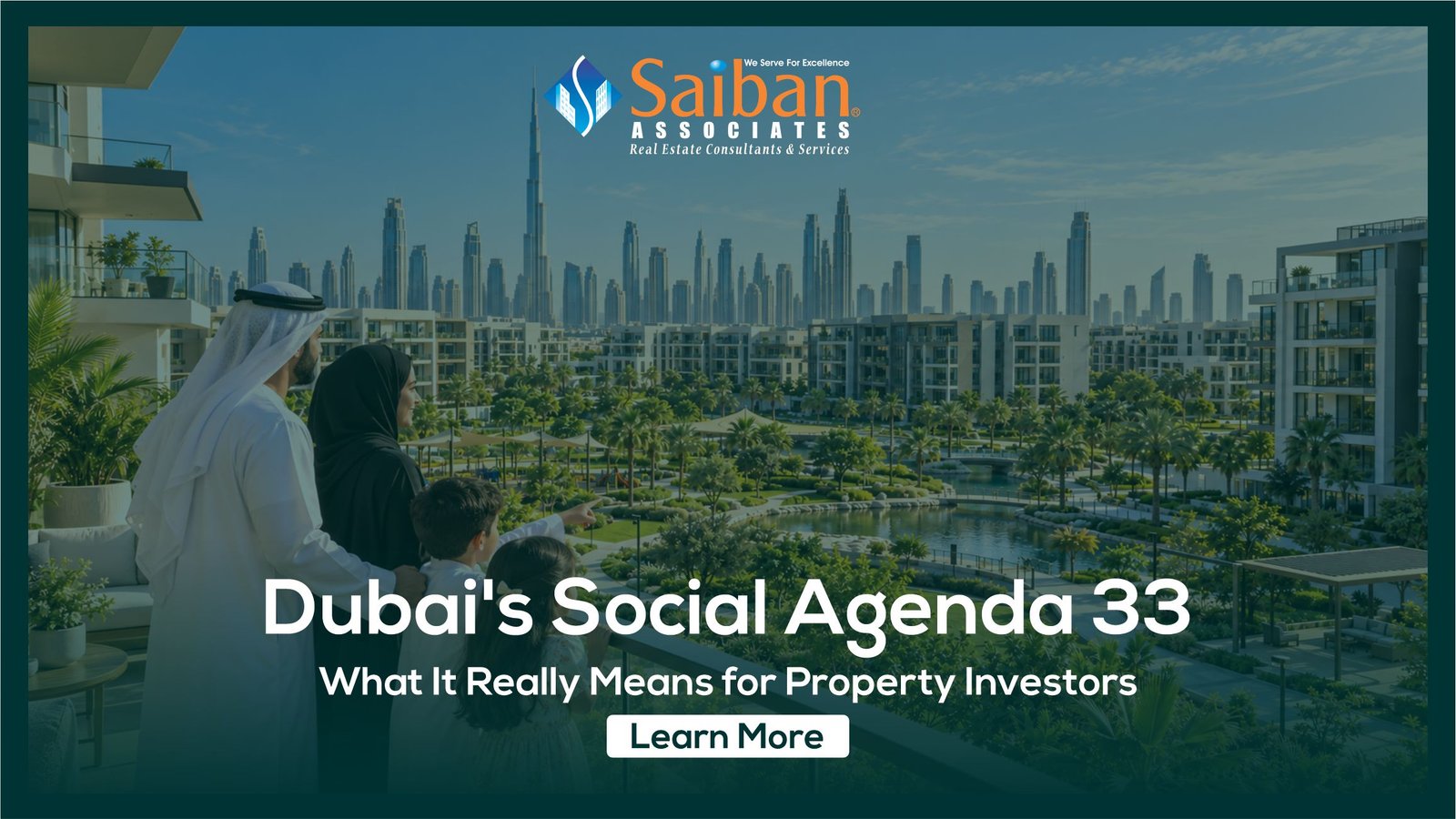
Dubai's Social Agenda 33 and What It Really Means for Property Investors (2026)
Every time Dubai announces a big government plan, the property headlines rush to call it a boost for investors. The latest is Dubai's social services action plan, part of the wider Dubai Social Agenda 33, and yes, it's a serious commitment to the city's future. But if you're weighing a property purchase, you deserve the honest version, not the hype. The truth is more nuanced: this is a citizen-focused social plan, its benefit to property investors is real but indirect, and it should inform your confidence in Dubai without replacing your due diligence on the actual unit you buy. Here's what it is and what it genuinely means for you.
What the Dubai Social Agenda 33 actually is
The Dubai Social Agenda 33 was launched by Sheikh Mohammed bin Rashid Al Maktoum in January 2024 as the emirate's ten-year social plan running to 2033, under the theme "Family: The Foundation of Our Nation." Its headline number is large: a government budget of around AED 208 billion over the decade, more than double the social spending of the previous ten years. The 2026 action plan for social services builds on that agenda by turning its ambitions into practical frameworks for delivering support across the emirate.
The money is organised mainly around two pillars. A healthcare pillar, funded in the region of AED 120 billion, aims to make Dubai's health system among the best in the world. And a community development pillar, funded around AED 88 billion, covers education, citizen support, social institutions, arts and culture, sport, and housing. Within that, the agenda earmarks funds for citizen support, social institutions, and the development of integrated residential communities. The stated goals are ambitious, including making Dubai one of the world's top three cities for standard of living and top ten for education and life expectancy, and it is designed to complement the Dubai Economic Agenda, D33.
Who the plan is really for
This is the part the property-focused write-ups tend to blur, so let's be clear. The Social Agenda 33 is primarily aimed at Emirati citizens and families. Its housing measures, land plots, and loans, and its goal of doubling the number of Emirati families in Dubai, are citizen programmes, not incentives for foreign buyers or a subsidy for overseas investors. Understanding that keeps your expectations honest. This is a nation building for its own people, and the investor angle is a knock-on effect, not the purpose.
How social investment connects to property
So why does it matter to an investor at all? Because liveability drives demand. A city that pours money into healthcare, education, community, and family life becomes a place more people want to live and work in, and sustained population and talent inflows are exactly what underpin long-term housing demand. Dubai's leadership has deliberately paired this social plan with its economic agenda, so growth and quality of life are meant to reinforce each other. For a long-term investor, that combination is a genuinely positive backdrop, because it supports the demand fundamentals that keep a property occupied and desirable over years, not months.
What it honestly means for investors
Here's the balanced takeaway. The Social Agenda 33 is a reassuring signal about Dubai's direction: a government investing this heavily in its people and its liveability is a government building for the long haul, which supports confidence in holding property here over time. That's real, and it's a fair reason to feel good about Dubai as a long-term market.
What it is not is a direct price driver, a guarantee of appreciation, or a reason on its own to buy any particular unit. A social plan aimed at citizens does not change the maths on your specific apartment, its price, its service charges, its rental demand, or its resale prospects. Treat it as one supportive factor in the big picture, alongside infrastructure, population growth, and economic policy, rather than a trigger to buy. The investors who do well in Dubai read these signals for context and then still do the hard work on the individual property.
What it does not mean, and the mistake to avoid
The mistake is letting a feel-good policy story stand in for due diligence. A strong social agenda will not rescue an overpriced unit, a weak developer, a poorly located building, or a purchase you can't comfortably fund. Government vision shapes the long-term environment; it does not underwrite your individual decision. So enjoy the confidence the plan reasonably provides, then judge every purchase on its own fundamentals, because that is what actually determines your return.
How to invest well, whatever the headlines say
Regardless of the policy backdrop, the discipline is the same. Buy in a location with real, verifiable demand, and confirm it with registered Dubai Land Department transaction data rather than asking prices. Calculate your net yield after service charges, maintenance, and vacancy, not just the gross figure, as our rental yields guide explains. Verify the developer and project for any off-plan purchase using our developer vetting guide. And build a diversified position over time rather than betting everything on a single unit or a single headline, which our guide on building a first UAE portfolio walks through. If you want to weigh the current market itself, our is now a good time to buy guide is the place to start.
Dubai's Social Agenda 33 is a strong long-term signal about where the city is heading, and that's worth factoring into your confidence as an investor. Just let it inform the picture, not make the decision. If you want a straight, numbers-first view on a specific opportunity, the team at Saiban Associates works with investors on exactly that. You can also browse current options on our projects page.
Want to talk through how Dubai's long-term outlook fits your investment plan? Message the Saiban Associates team on WhatsApp.