
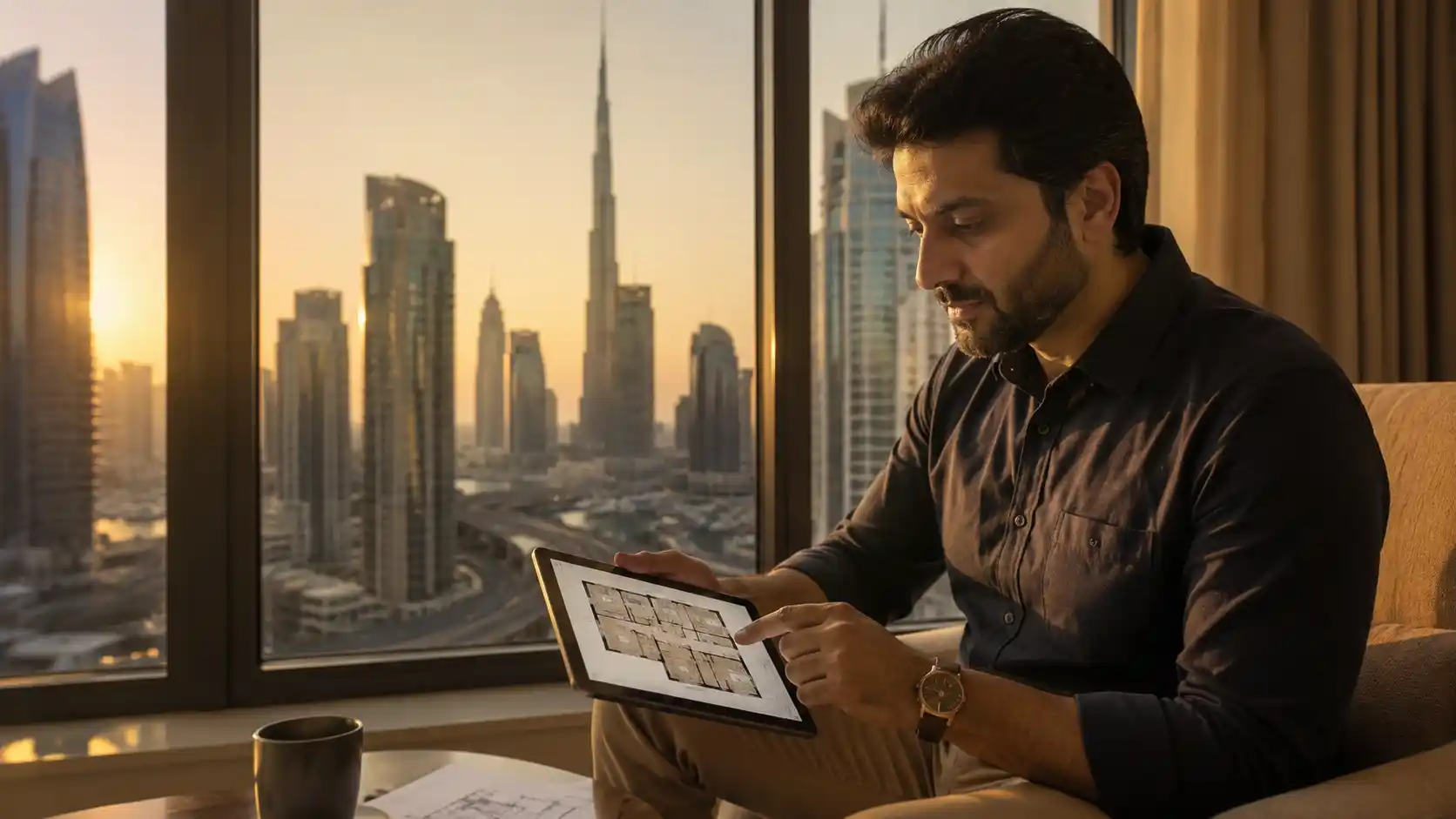
Picture an investor in Islamabad watching the rupee slide again, sitting on a plot file in some society that has not moved in three years, no development, no buyer, no exit. Same week, a friend books an off-plan apartment in Dubai for a small down payment and starts paying roughly one percent a month. One of them is stuck. The other has a title deed coming, rent in dirham, and a shot at a ten-year residency visa. That contrast, more than any glossy brochure, is why so much Pakistani money now flows to Dubai. If you have been wondering how to invest in foreign real estate, and specifically why investors from Islamabad keep choosing Dubai, here is the honest, numbers-first version.
Why Pakistani money, and Islamabad money in particular, keeps landing in Dubai
Start with the one that hurts: the rupee. When your savings are in PKR and the currency keeps weakening, holding a hard asset priced in dirham is a hedge, because the UAE dirham is pegged to the US dollar. Your Dubai property does not care what the rupee does next quarter. That single fact drives a huge share of the buying. Add the tax picture on top. The UAE charges no annual property tax and no capital gains tax on residential property owned by an individual, so your rental income and any resale gain are not taxed at source the way they might be elsewhere.
Then there is yield. Gross rental returns in Dubai commonly land around 6 to 8 percent, and higher in some apartment communities, which is stronger and far more liquid than most Pakistani plot investments that only pay off if and when you sell. Layer on 100 percent foreign ownership in designated freehold zones, the Golden Visa residency route, a regulated market with escrow protection for off-plan, and a two hour flight from Islamabad into a city with an enormous, settled Pakistani community. Put all of that together and the pull is obvious. Pakistanis have sat among the top five foreign buyer groups in Dubai, with their share of transactions estimated anywhere from roughly 7 to 11 percent depending on the quarter and the data source. Treat the exact percentage loosely, since the reports disagree, but the direction is not in doubt.
The Islamabad angle specifically
Capital-city money behaves a little differently. A lot of Islamabad buyers already deal in dollars, already travel, and already have family or business links in the Gulf, so Dubai does not feel foreign to them. Many have also been burned, or watched someone get burned, by a stalled local society where files traded briskly on paper while nothing got built on the ground. When you have lived through that, a RERA-regulated market with a developer escrow account and a government land department that actually records your title is a relief, not a luxury. That is the real emotional driver behind the Islamabad-to-Dubai flow. Not greed. Trust.
What "foreign real estate" actually costs you, beyond the sticker price
Here is where first-time overseas buyers trip. The advertised price is not your all-in cost. On a Dubai purchase you should budget roughly 6 to 8 percent of the property value on top for acquisition costs. The biggest single line is the Dubai Land Department transfer fee at 4 percent, which on a 2 million dirham property is around 80,000 dirham. Add an agency commission that is often about 2 percent, plus registration and admin charges. None of that counts toward your investment value. It is money spent, not money held.
After you own it, the main recurring cost is the annual service charge, billed per square foot by the building for maintenance, security and amenities. This is the number that quietly eats into that headline 7 percent yield, so always ask for the service charge per square foot before you fall in love with a rental figure. A high floor with a sea view and a heavy service charge can net you less than a plain unit with low fees. Run the net, not the gross. This is exactly the kind of detail our UAE desk pushes clients to check before they sign, because the brochure never leads with it.
The Golden Visa question everyone asks first
Almost every Pakistani buyer wants to know the same thing early: does this get me residency? As of mid-2026, buying Dubai property with a DLD-certified value of at least 2 million dirham, which is roughly 545,000 US dollars, puts you in line for the ten-year Golden Visa. A reform in February 2026 removed the old requirement to have paid a large chunk upfront, so mortgaged and off-plan units can now qualify as long as the total value clears the threshold. You can also combine more than one property to reach 2 million dirham. A studio plus a small apartment can add up to the number.
One caution, and I mean it. These rules have moved twice already in 2026, so do not treat any threshold or fee as permanent. Confirm the current position with an official source or a firm that tracks it before you buy on the assumption of a visa. And a piece of plain advice: do not buy purely to chase the visa. Buy an asset that makes sense on its own numbers, and let the residency be the bonus on top. A bad property with a Golden Visa attached is still a bad property.
Ready property or off-plan? The real trade-off
This is the fork most buyers face. A ready, handed-over unit means you can rent it out from day one and see cash immediately, but you pay full market price and need most of the money now. Off-plan means you buy from the developer before or during construction, usually on a staged payment plan, sometimes as gentle as one percent a month, which is what makes Dubai reachable for a mid-tier Pakistani salary rather than only the wealthy. The entry cost is lower and there is often capital appreciation between booking and handover.
The catch with off-plan is real and worth saying out loud. You are trusting a developer to deliver on time and to spec, and handovers do slip. That is why the developer's track record matters more than the render, and why you should only buy off-plan from a RERA-registered project where your payments sit in a regulated escrow account rather than going straight to the developer's pocket. This is the segment Saiban Associates works in every day. The SAMANA Developers projects we handle, which you can browse on our projects page including SAMANA Greenfield, are Dubai off-plan apartments on those one percent monthly style plans, structured so a buyer in Pakistan can invest without flying over for every step.
How to actually move your money and buy from Pakistan
The mechanics scare people more than they should, but there are a few rules you do not break. Move your money through formal banking channels, not through a hawala or a friend's personal account, however trustworthy the person sounds. Keep it documented, because a clean paper trail is what protects you later and keeps you on the right side of both UAE and Pakistani rules. Get current advice on the State Bank and FBR position on remitting funds abroad for a property purchase, since those rules change and you want to be compliant, not clever. You do not need to be a UAE resident to buy in a freehold zone. You buy, you register the title with the DLD, and residency, if you want it, follows the property.
The other half is choosing who you trust on the ground. Verify that the developer and project are RERA-registered. Confirm the escrow arrangement for off-plan. Do not wire a booking amount off the back of a WhatsApp forward and a screenshot. Working with a firm that has an actual UAE presence and has done these transactions before is the difference between a smooth purchase and a lesson. Saiban Associates' UAE desk coordinates exactly this for clients sitting in Islamabad, Lahore or the Gulf, from selecting the unit to handling the paperwork remotely. If you want to sanity-check whether Dubai or home makes more sense for your money first, our honest comparison, Dubai Property vs DHA Lahore, lays both sides out.
A simple framework for any foreign market
Dubai is the obvious answer for most Pakistanis, but the thinking travels to any overseas market. Before you invest in foreign real estate anywhere, work through five questions in order. First, what is the actual goal: rental income now, capital growth later, a currency hedge, or residency? The answer changes what you should buy. Second, is the market regulated, with a real land registry and escrow for off-plan, or are you relying on someone's word? Third, what is the true all-in cost after transfer fees, commissions and ongoing charges, not just the price on the listing? Fourth, ready or off-plan, and can you stomach the handover risk if it is off-plan? Fifth, how will you move money legally and how will you manage the property once you own it from another country?
Run any foreign market through those five and the weak options fall away quickly. For most people reading this, Dubai clears all five more comfortably than the alternatives, which is precisely why it keeps winning the Pakistani investor's attention. If you want ideas on where within Dubai the yield tends to sit, our piece on the top commercial areas in Dubai is a useful starting point.
So, is Dubai actually worth it for you?
Honest answer, with the downsides included. Dubai gives you a dollar-linked asset, real rental yield, a transparent registry and an optional residency, which is a genuinely strong package that Pakistan's domestic market cannot match on all four at once. But it is not free money. Service charges shave your net yield, so the 8 percent you were promised might live closer to 6 once the building takes its cut. Off-plan handovers can run late, and your capital is parked while you wait. And with more than 160,000 new units scheduled to land in Dubai in 2026, supply is rising and price growth has been cooling from its recent highs, so this is a buy-the-right-unit market now, not a buy-anything-and-flip one.
None of that is a reason to stay out. It is a reason to buy carefully: the right community, a credible developer, a service charge you have actually checked, and a plan for who manages the place. If you are weighing a first Dubai purchase from Pakistan and want a straight read on a specific project or a live payment plan, that is what our UAE team does. Message us on WhatsApp UAE or through the contact page with your budget and your goal, and we will tell you honestly whether the numbers work, even if the honest answer is wait.