Published 25 November 2026
Most "is it LDA approved?" questions in Lahore have a messy answer. A private developer, a layout plan, an NOC that may or may not cover the block you're looking at. Allama Iqbal Town is different, and the answer is much simpler than people expect. It isn't a private society that the LDA approved. The LDA built it.
That single fact changes what you need to check before buying here. So this guide starts with the LDA question, then walks through everything else a buyer actually asks about Iqbal Town: where it is, its 26 blocks, its markets and park, and what the published price data says. Every price is labelled for what it is, an asking-price average or a tax value. None of them is a confirmed sale price.
The short answer: Yes, in the sense that matters. Allama Iqbal Town is an LDA Regular Scheme, developed by the Lahore Development Authority itself. There's no private developer, so there's no developer approval to check. What you still need to check is the individual plot or house: its title, its seller and its permitted use.
Why the LDA question works differently here
When people ask whether a society is LDA approved, they're really asking whether a private developer got the LDA's permission to build it. That's the right question for most of the schemes along Lahore's newer corridors. It's the wrong question for Iqbal Town.
Allama Iqbal Town is an LDA scheme. The LDA's own list of schemes calls it a "Regular Scheme". A copy of that list taken on 13 October 2026 describes it as an "LDA Regular Scheme (developed by LDA itself, not a private scheme)". Property portals say the same thing in their own words. Mehal.pk describes it as an "LDA regular scheme, 99% colonised". Milkiyat.com calls it a "fully developed LDA scheme of about 12,800 kanal". And Zameen listings for the area describe it as an "LDA Approved Society... Completely An LDA Scheme".
So the approval question dissolves, the same way it does for Gulberg. There's no private developer behind Iqbal Town, and no developer approval to look up, because the authority that approves private schemes is the one that developed this one.
You'll sometimes see people quote an approval date or an NOC number for Iqbal Town. I haven't found a verified one, and I'm not going to print one. It's also not on the LDA's illegal list. If anyone shows you a document claiming otherwise, ask for the source and check it yourself.
What "LDA scheme" doesn't protect you from
Here's the honest catch. A government-developed scheme tells you the land plan is legitimate. It tells you nothing about the specific property in front of you. Iqbal Town has been lived in since the early 1980s, which means decades of transfers, inheritances, extensions and conversions. Older areas carry older paperwork, and that's where problems hide.
Your checks here are about the property, not the scheme:
- Title: who owns it now, and does the chain of ownership hold together?
- The seller: is the person selling actually the owner, or holding a power of attorney you need to verify?
- Use: is it residential or commercial, and does what's built on it match?
- Building approvals: for a house, were the extensions and extra floors approved?
That's a different job from checking a private society, where the first worry is whether the society itself is legal. For contrast, our guides on Hamza Town Phase 2 and Zam Zam City Lahore show what that check looks like for private schemes, and our list of LDA approved societies in Lahore covers the wider picture.
How to verify it yourself
Don't take my word for it, or any portal's. The LDA publishes its scheme lists and runs an online portal for checks. Our LDA online portal guide walks through how to use it step by step. Look for Allama Iqbal Town among the LDA's own schemes, and for any property-level check, use the portal or visit the LDA with the plot details in hand. If something you're told doesn't match what the LDA shows, the LDA wins.
A short history of Iqbal Town
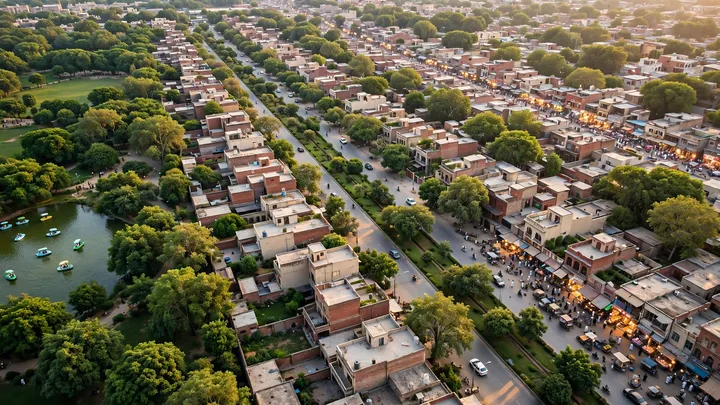
Allama Iqbal Town, usually just called Iqbal Town, is named after Allama Iqbal. It's a residential and commercial locality in Iqbal Tehsil, in south-western Lahore.
It was planned in the 1970s on about 1,600 acres of former farmland near Bhikhewal and Nawan Kot. By the early 1980s it had become a major residential area. Gulshan-e-Iqbal Park opened in April 1982, around the same time the town was filling in.
It also has a film-industry history. Shahnoor Studios and Bari Studios are very close to the area, and Lollywood film actors used to live here.
About 1,600 acres works out to about 12,800 kanal, which matches the figure milkiyat.com gives. That's a big scheme by Lahore standards, and most of it is built.
Where Iqbal Town is
Iqbal Town is bounded by Multan Road and Wahdat Road. Its main boulevard starts at Scheme Mor (also written Scheme Moar, "moar" meaning corner) on Multan Road, runs to Wahdat Road, and carries on towards Punjab University's New Campus.
Across Multan Road is Awan Town, which we covered in detail in our guide on whether Awan Town Lahore is LDA approved. Sabzazar is nearby too. If you're weighing Iqbal Town against the newer options further out along the same road, our guide to housing societies on Multan Road covers that corridor.
All 26 blocks of Iqbal Town
Iqbal Town is divided into 26 named blocks:
Asif, Badr, Chenab, College, Gulshan, Huma, Hunza, Jahanzeb, Khyber, Kamran, Karim, Kashmir, Mehran, Muslim, Nargis, Neelam, Nishtar, Nizam, Pak, Rachna, Raza, Ravi, Sikander, Sutlej, Umar and Zeenat.
Six of them sit on the main boulevard: College, Pak, Asif, Kashmir, Huma and Jahanzeb.
You'll see different spellings in listings and on signboards. Badr is also written Badar, Sikander as Sikandar, Neelam as Neelum, Sutlej as Satluj, Chenab as Chinab, and Jahanzeb as Jahanzaib. They're the same blocks. When you search listings, try both spellings, or you'll miss half of what's on offer.
Which blocks get the most attention? Zameen's data on the most searched blocks in Iqbal Town puts Neelam at 14.4% of searches, Ravi at 12.8%, Pak at 10.2%, Karim at 9.7% and Raza at 6.3%. Searches aren't sales, but they do tell you where buyers are looking first.
Markets: Karim Block, Moon Market and Jinnah Market
Karim Block Market, along Wahdat Road, is one of Lahore's busiest markets. It has hundreds of garment outlets and factory outlets, including Levi's, Outfitters, Minnie and Minors, Shirt and Tie and Royal Tag. There are banks, Gourmet Bakery and petrol pumps along the same stretch. Jinnah Market is also in Karim Block.
Moon Market is at Dubai Chowk, and it has a parking plaza.
For residents, this is a real advantage. Daily shopping, banking and a big clothing market are all inside the town. The flip side is the obvious one. A market that busy brings traffic and crowds with it, so a house right next to it is a different experience from one deeper inside a quieter block.
Gulshan-e-Iqbal Park
Gulshan-e-Iqbal Park is in Gulshan Block. It covers 67 acres and opened in April 1982. It has an artificial lake with boating, rides, a mini zoo and a zipline, and there's a buggy tour at PKR 50 per person. The park has four entrances, the main one on Fazal-e-Haq Road, and it's maintained by the Parks and Horticulture Authority (PHA).
A 67-acre park inside the town is a big part of why families look at Iqbal Town. If having green space within reach matters to you, the blocks closest to Gulshan Block are worth a look.
Education and healthcare
Allama Iqbal Open University's Lahore campus is in Raza Block. Punjab University's New Campus is at the end of the main boulevard. It's nearby, not inside the town, but the boulevard connects the two directly.
For healthcare, area guides name Farooq Hospital, Al-Shafi Hospital, Najam Clinic, Munawar Medical Complex, Dental Art and Bajwa Hospital in the area, with Sheikh Zayed Hospital nearby. Check services and timings directly with each one, because what a facility offers can change.
Iqbal Town property prices: what the published numbers say
Plots and houses in Iqbal Town are most commonly listed in 5, 7, 10 and 15 marla and 1 kanal sizes. Here's what the data says, with every figure labelled.
Zameen Index asking-price averages, September 2026
These are averages of asking prices on Zameen, not sale prices.
| House size (Iqbal Town) | Average asking price, Sep 2026 | 6 months earlier | 12 months earlier |
|---|---|---|---|
| 5 marla | PKR 2.73 crore | PKR 2.51 crore | PKR 2.43 crore |
| 7 marla | PKR 3.24 crore | ||
| 10 marla | PKR 4.71 crore | PKR 4.57 crore | PKR 4.44 crore |
Where a cell is blank, there's no earlier figure in the data. Two patterns stand out. First, 5 marla houses moved faster: up about 12.3% in 12 months, against about 6.1% for 10 marla houses. Second, in the last six months the 5 marla average rose about 8.8% while the 10 marla average rose about 3.1%. Smaller houses are where asking prices have been climbing quickest.
Block by block: why the block matters
The town-wide average hides big differences between blocks. Here's what the Zameen Index showed for three blocks over six months:
| Block and size | Apr 2026 | May | Jun | Jul | Aug | Sep 2026 |
|---|---|---|---|---|---|---|
| Zeenat Block, 10 marla houses | PKR 4.19 cr | 4.31 | 4.53 | 4.71 | 4.81 | PKR 5.09 cr |
| Pak Block, 15 marla houses | PKR 4.96 cr | 5.16 | 5.31 | 5.47 | 5.64 | PKR 5.97 cr |
| Nishtar Block, 15 marla houses | PKR 2.99 cr | 3.11 | 3.17 | 3.24 | 3.33 | PKR 3.4 cr |
All figures are average asking prices in PKR crore. Look at the two 15 marla rows. In September, Pak Block's average asking price for a 15 marla house was PKR 5.97 crore. Nishtar Block's was PKR 3.4 crore. Same town, same size, a gap of more than PKR 2.5 crore. Pak Block sits on the main boulevard. That doesn't prove the boulevard explains the whole gap, but it's the kind of thing that moves prices in an older scheme.
Zeenat Block's 10 marla average rose from PKR 4.19 crore in April to PKR 5.09 crore in September, about 21.5% in five months. Pak Block's 15 marla average rose about 20.4% over the same stretch, and Nishtar Block's about 13.7%. And notice that Zeenat Block's 10 marla average is above the town-wide 10 marla average of PKR 4.71 crore.
It works the other way too. The Zameen Index put Neelam Block's 5 marla average asking price at PKR 2.34 crore in September, below the town-wide 5 marla average of PKR 2.73 crore. Neelam is also the most searched block. Lower asking prices plus the most searches is a combination worth noticing if you're on a 5 marla budget.
One real listing, for a sense of scale
In October 2026, one listing on Zameen offered a 10 marla house in Hunza Block at PKR 4.5 crore. That's one seller's asking price for one house. It isn't an average and it isn't a sale. It sits a little below the town-wide 10 marla average, which is a useful reminder that individual asks vary around the averages.
FBR values: the tax floor, not the market
The FBR's valuation table for Lahore is SRO 1722(I)/2024, dated 29 October 2024. It still applies to Iqbal Town, because the later SRO 876(I)/2026 of 19 May 2026 changed only the DHA rows. The row for "Allama Iqbal Town, all blocks" reads:
| Category | FBR value |
|---|---|
| Residential open plot | PKR 14,24,400 per marla |
| Commercial open plot | PKR 59,96,760 per marla |
| Residential building | PKR 2,000 per sq ft of covered area |
| Commercial building | PKR 2,500 per sq ft of covered area |
Let me be plain about what these numbers are. FBR values are the minimum value used for federal withholding taxes: Section 236K when you buy and Section 236C when you sell. They aren't market prices.
The arithmetic shows the gap. A kanal is 20 marla, so the FBR residential open plot value for 1 kanal in Iqbal Town is about PKR 2.85 crore. For 10 marla, it's about PKR 1.42 crore. Now compare that with the Zameen Index average asking price for a 10 marla house: PKR 4.71 crore. The FBR figure is for the land only, and a house would add its covered area at PKR 2,000 per sq ft, but even so the tax value sits well below what sellers are asking. Your tax is worked out on at least the FBR value. Your price is whatever you and the seller agree.
What about rent?
I looked for a verified rent index for Iqbal Town and didn't find one I'd rely on. So there are no rent figures in this guide. If you're buying to rent out, get current rents from local dealers for the specific block and size, and get more than one.
My honest take on Iqbal Town
Iqbal Town's biggest selling point is the one this guide started with. It's an LDA scheme, fully developed, and mostly built. Mehal.pk calls it 99% colonised. You're not buying into a plan or waiting on a developer. You're buying into a neighbourhood that has existed for over four decades, with a major market, a 67-acre park and a university campus on its doorstep.
That same maturity is the downside. A scheme that's 99% colonised has very little empty land left, so most of what you'll be offered is existing houses, some of them old. That means more work on paperwork, more attention to what's been built without approval, and a proper look at the condition of the structure. And Karim Block Market's busyness is great for shopping and less great if you live next to it.
If I were buying here, I'd decide on the block before the house. The data above shows how much the block matters. Pak Block and Zeenat Block are asking much more than Nishtar or Neelam. Decide whether you want the boulevard, the park, or simply the best price per marla, then search those blocks under every spelling.
And if you're still comparing Iqbal Town with the rest of Lahore, our guide to the best places to live in Lahore and our list of housing societies on Ferozepur Road cover the alternatives. If a DHA file is also on your list, the daily DHA file rates page shows where those prices sit today.
Iqbal Town and Iqbal Garden are not the same place
One quick warning, because the names are close. Iqbal Garden is a different project. It isn't part of Allama Iqbal Town, and nothing in this guide applies to it. If you see "Iqbal" in a listing, check which one it means before you go any further.
Before you buy in Iqbal Town: a short checklist
- Confirm the block, under every spelling. Badr or Badar, Neelam or Neelum. The block changes the price.
- Check the title chain. Older houses often have longer histories. Make sure every step holds up.
- Verify the seller. If someone is selling on a power of attorney, check it properly.
- Check the use and the building. Residential or commercial, and were the floors and extensions approved?
- Compare at least two asking prices for similar houses in the same block.
- Work out your withholding taxes on the FBR value before you agree a price, and ask your tax adviser how 236K applies to you.
Want a second opinion?
If you're looking at a house or plot in Iqbal Town and want someone to go through the paperwork, the block, and how the asking price compares with the data in this guide, message the Saiban Associates team on WhatsApp. It's especially useful if you're buying from abroad and can't walk the street yourself.