A Pakistani buyer messaged me last week. He had AED 600,000 saved, a cousin in Dubai telling him to buy in Dubai South, and a WhatsApp group telling him the area is about to crash under its own supply. He asked me one question: who is right? I told him the truth, which is that both sides are holding a real piece of data. Dubai South just recorded more property transactions in a single quarter than anywhere else in Dubai. At the same time, two-thirds of every apartment landing in Dubai over the next four years is a studio or one-bedroom. This is a post about what both of those facts mean for you, and for your money.
What the October numbers actually say about Dubai South
Let's start with what is not in dispute. In Q3 2026, Dubai South recorded 5,165 residential transactions at an average of AED 1,690 per square foot, making it the most-transacted residential location in Dubai for the quarter. JVC came second with 2,312 deals, and Downtown Jebel Ali third with 1,890. This data was published on October 5, and it's drawn from registered transaction activity, not marketing talk.
That number is even bigger than it looks when you zoom out. The whole of Dubai did 33,949 residential sales worth AED 72.58 billion in the quarter, and off-plan accounted for AED 41.58 billion of it. Below AED 3 million made up more than 84% of transactions. So Dubai South isn't an outlier because of a few luxury launches. It's the centre of gravity of the mid-market, the part of Dubai where ordinary buyers are actually buying.
The studio story is what really jumps out. A fäm Properties analysis reported on September 30 found that studio sales in Dubai South surged 185% to 11,147 units in the first eight months of 2026. That is more than half of all studio sales in Dubai in that period. Across the emirate, total studio sales rose 26% to 21,728 units, while one-bedrooms fell 18%, two-beds fell 16%, and three-beds fell 13%. Buyers are going smaller. Way smaller.
And the run is not new. Dubai South was the best-performing primary-market area for the sixth straight month in August, with 1,908 off-plan transactions worth AED 2.3 billion, per fäm data published through IndexBox and TradeArabia on September 10. The best-selling primary apartment project in all of Dubai that month was Azizi Venice 15 Building B in Dubai South: 344 units at a median price of AED 703,600. Six months at the top of the off-plan table is not a fluke. It's a pattern.
So the boom side of the question is real, and it's measurable. The area is absorbing enormous volume at prices around AED 1,500–1,700 per square foot, mostly off-plan, mostly studios. But volume is a fact about demand, not a guarantee about returns. That's where the other half of the data comes in.
Why AED 500,000–700,000 is Pakistan's Dubai entry ticket
There is a specific price band where Pakistani first-time Dubai investors cluster, and Dubai South owns it. Current listings show entry-level studios from around AED 480,000–500,000, with most off-plan studio inventory sitting between AED 500,000 and AED 700,000. Ready studios in established buildings average about AED 630,000, based on 2026 listing data.
At today's rate of roughly AED 1 = PKR 75.26, that puts a AED 500,000 studio at about PKR 3.76 crore and a AED 700,000 unit at about PKR 5.27 crore. A ready studio at AED 630,000 lands around PKR 4.74 crore. Keep that exchange rate in mind for everything below, because the rupee moved nearly two rupees against the dirham over the past year, and every number you see in dirhams costs you a currency calculation too.
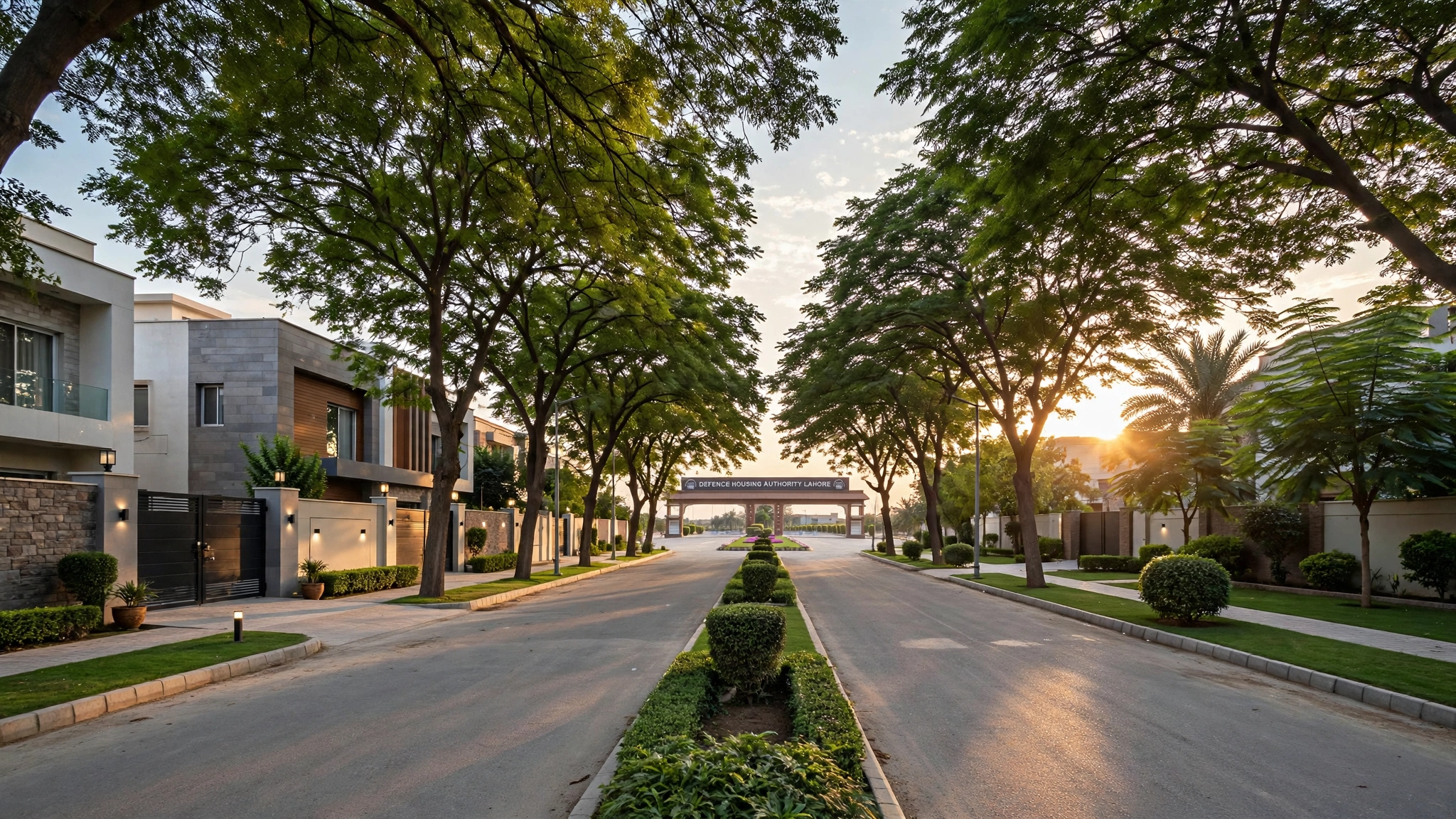
Why does this band matter so much to Pakistani buyers? Because for many, it's the difference between entering Dubai and staying out of it. A AED 600,000 studio is less than what a decent DHA Lahore house file goes for in several phases. It's within reach of a family that has saved in rupees or dirhams over a few years of Gulf work, especially with the 50/50 and monthly-installment payment plans developers are offering. Some projects advertise book-with-5%-down style structures. If you want the full rupee math on Dubai entry points, our Dubai property prices in PKR guide walks through the conversions.
But here is the thing the brochures skip. Almost everyone buying in this band is buying the same product: a small off-plan studio, handing over between 2027 and 2029, priced around AED 1,500–1,700 per square foot. When thousands of buyers buy the identical product in the same few square kilometres, the resale and rental competition isn't theoretical. It's your future neighbours.
The airport story: steel in the ground, not a brochure promise
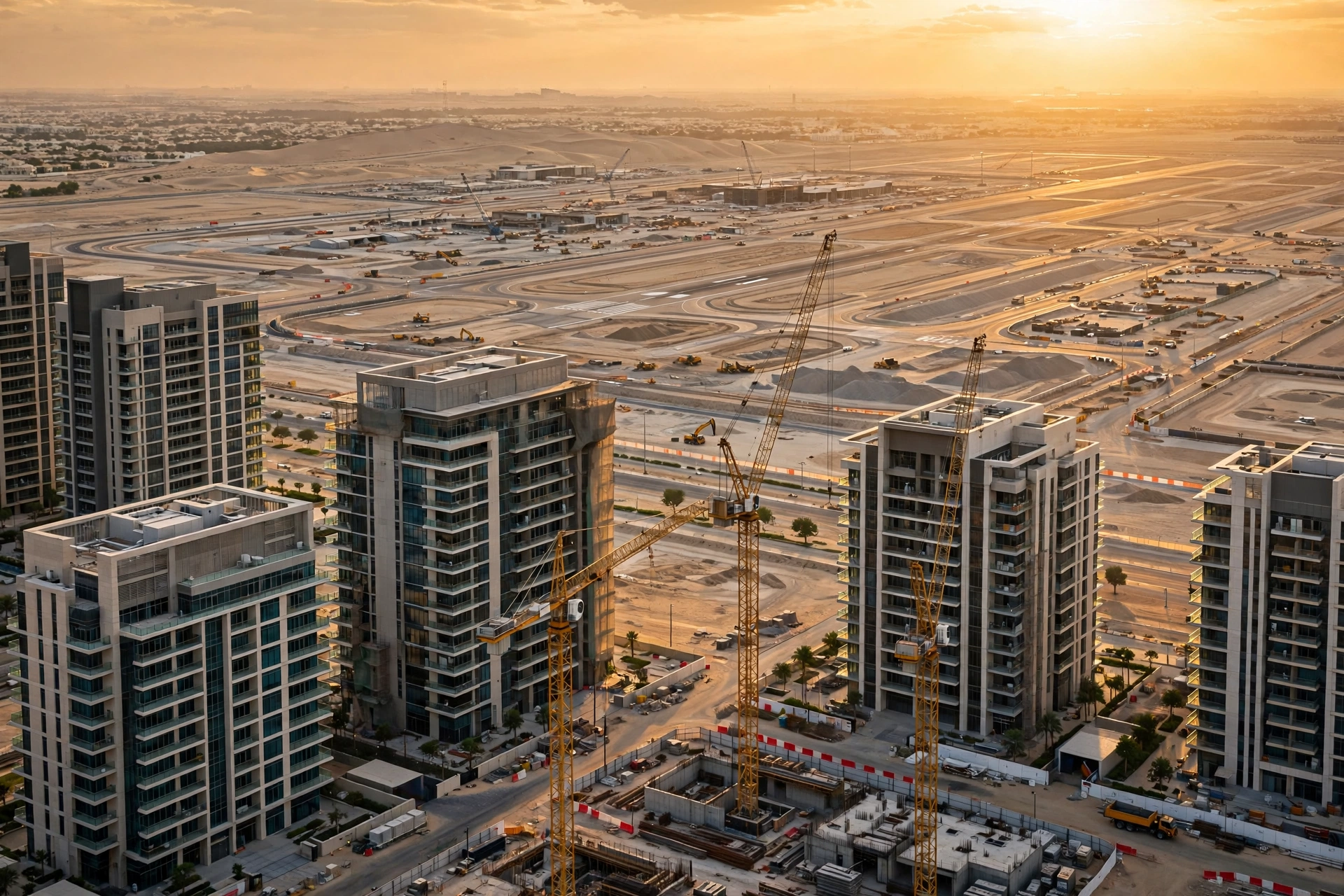
Every Dubai South pitch has one line in it: the airport. And for once, the infrastructure story behind a Dubai development is not marketing fluff. It's a genuine mega-project with money actually moving.
In April 2024, Sheikh Mohammed bin Rashid Al Maktoum approved an AED 128 billion expansion of Al Maktoum International Airport. The full build-out is designed for 260 million passengers a year, five parallel runways, 400 gates, and 12 million tonnes of cargo across 70 square kilometres. Phase one is targeted for 2032, with capacity for around 150 million passengers through a new terminal and concourses.
Dubai Airports CEO Paul Griffiths said in August 2026 that contracts worth AED 13 billion were already under construction, with a further AED 55 billion due to be awarded before the end of 2026. On the ground, more than 17,000 concrete piles are in, over 45 million cubic metres have been excavated, and the second runway is finished. The workforce is expected to grow from around 9,000 today to a peak of about 120,000. You don't mobilise 120,000 workers for a project you're not serious about.
This is the fundamental, long-term demand story for Dubai South. An airport that big creates jobs in aviation, logistics, cargo, and services. Jobs create tenants. Tenants fill studios. Over a ten-year horizon, that logic is solid.
Now the honest part. Dubai has promised this airport before. The original DWC expansion plan, announced around 2013–2014 with a $32 billion budget, targeted completion by 2022. That timeline slipped, and the project was frozen in 2019 before COVID extended the pause. Work only restarted at scale in 2024. The 2032 date has real contracts behind it this time, which the earlier dates arguably did not, but it's still six years away. If you're buying a studio that hands over in 2028, you're renting it into a market where the airport is a construction site with 100,000 workers, not a finished hub. That's fine for rental demand from workers and contractors, which is real demand, but don't price your investment as if the 260-million-passenger hub already exists.
The honest risk: thousands of studios, one neighbourhood
This is the section the "oversupply trap" people are really talking about, so let's give their data the same respect I gave the boom data.
Cushman & Wakefield Core's analysis, published in September, puts the Dubai pipeline at more than 400,000 residential units under construction or announced for delivery between 2026 and 2030. Three details matter more than the headline. 86% of the pipeline is apartments. 66% of it is studios and one-bedrooms. And 45% of it sits in just five districts: JVC/JVT, Dubai South, MBR City, Business Bay, and Dubailand Residence Complex. The research head at Cushman & Wakefield Core said it plainly: with two-thirds of upcoming supply being small units, oversupply risk is elevated for studios and one-beds in high-delivery districts. Dubai South is named as one of those districts.
The near-term numbers sharpen the point. Property Monitor data shows 577 projects and 146,165 units scheduled for completion in 2027, with another 565 projects queued for 2028. Dubai is expected to deliver around 55,600 homes in 2026, the highest annual volume since 2008, and 60,000–75,000 a year after that. Working with a realistic delivery assumption, that's roughly 34,000 studios and one-bedrooms landing every year until 2030, concentrated in a handful of districts. Your Dubai South studio will be competing for tenants against a wave of identical units.
Now, the nuance. Dubai has never delivered its announced pipeline in full or on time. Phasing, contractor capacity, and developer pacing push handovers back by years, and a meaningful share of announced projects never break ground. Sell-through on new launches shows the market still absorbs product: the median launch in 2025 sold nearly three-quarters of its units. And citywide absorption ran at 91–96% against new supply in Q1 2026. This isn't a market with empty towers. It's a market where the risk is about what happens in 2027–2029, not what has happened already.
The fäm data tells us how the market is adjusting so far: through volume, not price cuts. Only 44 of 717 off-plan projects, about 6%, cut prices by 5% or more since February 2026, and just 4% are selling below launch price. Developers are holding their headline prices and letting absorption slow instead. That works for developers. For you, it means the risk shows up in your life as longer void periods between tenants, lower rents than the launch-day brochures projected, and resale listings that sit next to fifty similar units. If you're trying to model what your studio actually rents for after handover, start with our Dubai rental yield and ROI breakdown before you believe any agent's number.
The team at Saiban Associates tracks this absorption data quarter by quarter for exactly this reason. A studio in a project that sold 90% of its units at launch has a very different resale profile from one where half the building is still unsold at handover, even at the same price per square foot. That distinction never appears in a brochure.
What I'd tell a friend sitting in Dubai or Riyadh with AED 600,000
If you are reading this from Dubai, Riyadh, or Doha with around AED 600,000 to deploy, here's how I'd actually think about it.
First, separate the timeline. Are you buying a place you might live in, or a rental asset you will never visit? If you might live in it, Dubai South is genuinely undervalued relative to where you will be commuting. If it is purely an investment, you're betting on rental demand from airport and logistics workers plus capital appreciation as 2032 approaches. Both are real theses. Neither is guaranteed.
Second, pick your project like your money depends on it, because it does. Median projects priced more than 20% above their area median sold only about 60% of their units, versus nearly 74% for sensibly priced ones. That gap is your future resale competition. I wouldn't touch a studio priced at AED 1,900 per square foot in an area trading at AED 1,600, no matter how nice the renders look. The data says the market punishes overpricing with slow absorption, and slow absorption becomes your problem at resale.
Third, decide between ready and off-plan honestly. Ready studios from around AED 450,000–500,000 rent from day one and qualify for nothing less than the usual residency routes, while off-plan buys you a lower entry price and a payment plan in exchange for two to three years of zero income and delivery risk. There is no universally right answer. There is only the answer that fits your cash flow.
Fourth, understand that a AED 500,000–700,000 studio doesn't get you a Golden Visa on its own. That route starts at AED 2 million in property investment. If residency planning is part of your thinking, read our piece on the Dubai Golden Visa rules for Pakistanis before you sign anything.
And the one thing I would warn every Pakistani buyer about: verify the developer's escrow and your own title independently. Off-plan in Dubai is regulated through escrow accounts and the Dubai Land Department, which is a far stronger system than anything in Pakistan, but the protection only works if your payments actually go into the registered escrow and your unit is actually registered. For a broader look at how Pakistani buyers compare vetted projects, our off-plan projects guide for Pakistanis is a decent starting point.
If you're buying from Pakistan: the paperwork no one mentions
A lot of the AED 500,000–700,000 demand in Dubai South comes from buyers who will never stand inside the unit before paying for it. If that is you, the purchase process has extra steps, and the agents who gloss over them aren't the agents you want.
You can absolutely buy in Dubai without being a UAE resident. What you need is a valid passport, and for the money movement, a clean banking trail. Pakistanis buying from Pakistan typically remit through their bank under the State Bank's foreign investment channels, keeping every transfer slip. Don't send money through informal channels for a property purchase. The documentation of your remittance is what proves your funds are legitimate, and you'll need that paper trail for both the Pakistani and the Dubai side of the transaction.
You don't need a Power of Attorney if you can travel to Dubai for the signing. If you can't, a POA attested for use in the UAE lets a trusted person, or your agency, sign on your behalf. This is standard practice, and any agency that handles overseas Pakistani clients should be able to walk you through the attestation steps without hand-waving.
The check that matters most happens before any money moves. Your unit's title and the developer's project registration should be verifiable with the Dubai Land Department, and your stage payments should go into the project's registered escrow account, not the developer's operating account. Ask for the escrow account details in writing. A legitimate developer provides them without hesitation.
This is the part of the process where distance genuinely hurts you, and where I think buyers should be most careful about who represents them. Our guide to investing in Dubai from Pakistan goes deeper on the remittance and documentation steps. And for what that budget buys you relative to other cities, the AED 1 million comparison across Dubai, London, Lahore, Toronto, and Singapore puts the entry price in perspective.
Who Dubai South is actually for
So, boom or oversupply trap? My honest take is that it's a boom with a trap built into one specific segment, and you can tell which one you're buying into before you sign.
Dubai South is a genuine growth story. The transaction data is not a marketing claim. 5,165 deals in a quarter, six straight months topping the off-plan table, studios up 185%, and a AED 128 billion airport with AED 13 billion of contracts already under execution and 17,000 piles in the ground. The infrastructure thesis is real, the demand is measurable, and the entry price of AED 500,000–700,000, about PKR 3.76–5.27 crore, is the most accessible in Dubai. For a Pakistani buyer who wants Dubai exposure without Gulf-level savings, there is no cheaper on-ramp.
The trap is equally real, and it has a name: concentration. Two-thirds of the coming supply is studios and one-beds, nearly half of it is landing in five districts, and Dubai South is one of them. If you buy an overpriced studio in a slow-selling project and the 2027–2029 handover wave hits your building at the same time as three neighbouring towers, your rent and your resale both suffer. That isn't a crash prediction. It's arithmetic.
What I wouldn't do is buy the cheapest studio in Dubai South assuming the area's transaction volume guarantees my return. Volume is developers selling. Returns are tenants renting and buyers reselling. Those are different people, and the second group is about to have a lot of choice.
What I'd do, if I had AED 600,000 and a five-to-ten-year horizon, is buy a well-priced unit in a fast-absorbing project, hold through the 2028 handover wave, and let the airport construction workforce and then the 2032 opening do the long-term work. Boring answer. But boring is usually where the money is.
Where Pakistani investors in Dubai often start
Most Pakistani buyers comparing Dubai entry points start by checking what the same budget buys elsewhere and how the yields actually pencil out, which is why our guides on where to invest AED 2 million in Dubai right now and Dubai rental yields and ROI get the most read time on this site. If you want a second pair of eyes on a specific Dubai South project, payment plan, or escrow setup before you commit, message the Saiban Associates team on WhatsApp.