
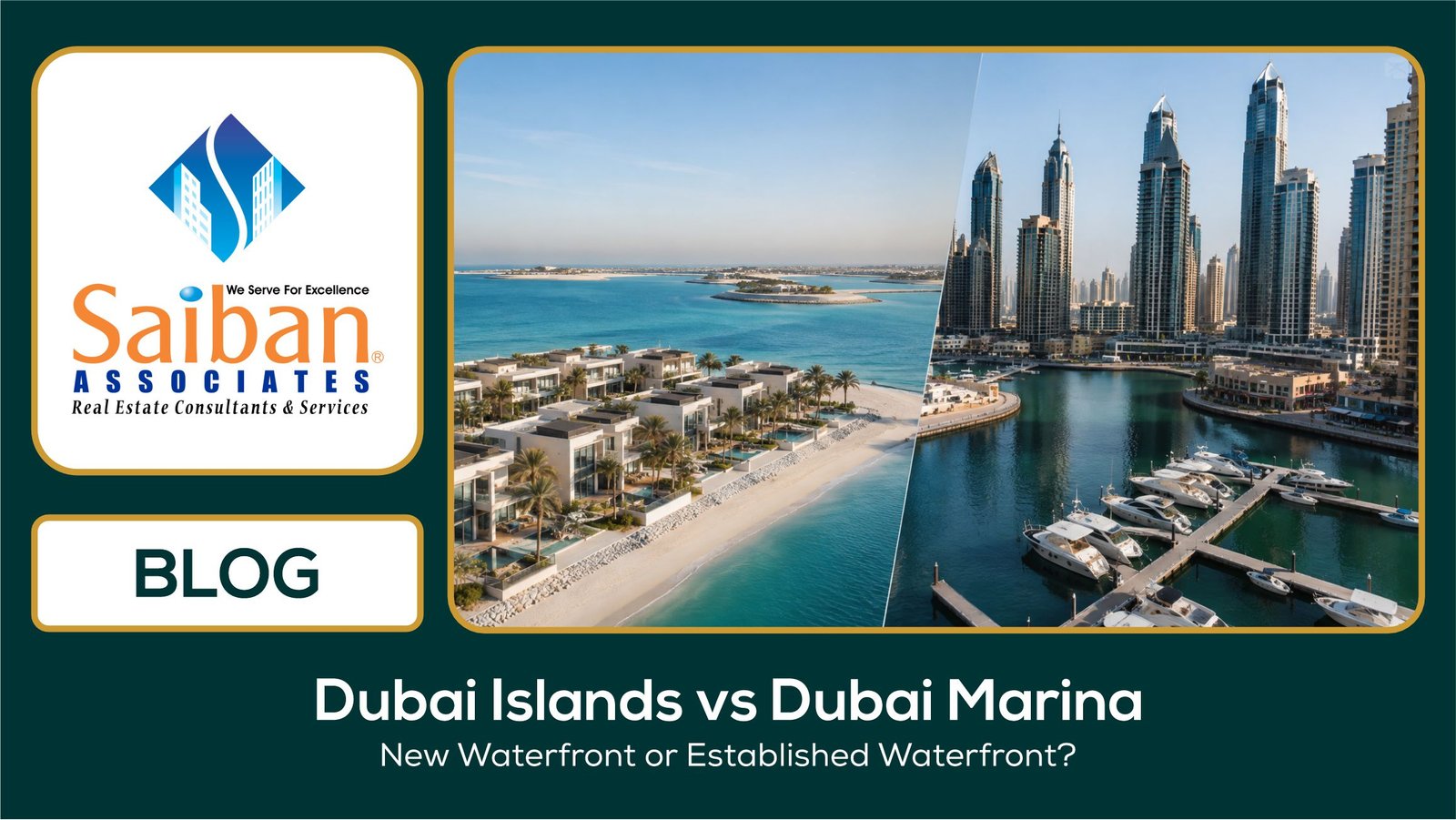
Both put you on the water in Dubai, but they ask you to make very different bets. Dubai Islands is the new coastline, a master plan still filling in, where you're buying into what the place will become. Dubai Marina is the finished article, a mature waterfront with towers, a promenade, a metro line, and years of rental history you can actually check. So the honest way to frame this isn't "which is better," because that has no universal answer. It's "which bet fits your money, your patience, and your appetite for risk." Here's how the two really compare in 2026.
The quick version
Dubai Islands suits a buyer who can wait. You're entering an emerging destination before its beaches, hotels, retail, and public spaces have fully arrived, hoping the value rises as they do. Dubai Marina suits a buyer who wants proof and income now, a ready apartment in a district with established demand, transport, and visible rental and resale data. One trades certainty for growth potential. The other trades top-end growth for evidence and liquidity.
| Factor | Dubai Islands | Dubai Marina |
|---|---|---|
| Stage | Emerging, still being built | Mature and fully occupied |
| Typical buy | New and off-plan | Ready and resale |
| Main case | Future growth | Income and liquidity |
| Lifestyle | Beach-led, low-density | Urban marina, high-rise, dining |
| Transport | Roads, future links | Metro, tram, established roads |
| Main risk | Delivery timing and supply | Tower age, congestion, competition |
What you're really buying in Dubai Islands
Dubai Islands is a new coastal destination on Dubai's northern shoreline, a Nakheel master plan spread across a cluster of islands with kilometres of new beaches, parks, marinas, promenades, and hospitality planned. It sits close to Deira, Dubai Creek, and Dubai International Airport, which is a genuine locational strength.
The appeal is forward-looking. You're not just buying today's neighbourhood, you're buying the expected value of everything that's coming: the beaches that open, the hotels and restaurants that fill in, the resident demand that builds as the district matures. That's the upside. The flip side, and you should sit with this honestly, is that a lot of what makes the pitch attractive doesn't exist yet. Handover dates can move, you may live beside active construction for a while, and future launches can add competing supply right when you want to rent or sell. The growth story is real, but so is the wait.
What you're really buying in Dubai Marina
Dubai Marina is one of the city's best-known waterfront addresses, and it earns that with a complete, working lifestyle: towers, the marina walk, restaurants, retail, leisure, and easy access to JBR. Crucially for anyone who doesn't want to depend entirely on a car, it has both the Dubai Metro and the Dubai Tram.
For an investor, that maturity is the whole point, because it gives you evidence. You can inspect the actual building, read its service charges, see achieved rents rather than projected ones, and compare real resale listings. The catch is selection risk. Two apartments in the same marina can perform completely differently depending on the tower's age and maintenance, the view, the layout, parking, traffic access, and how many similar units are competing against yours. In Marina, picking the right building matters as much as picking the area.
Comparing them without fooling yourself
Here's where most people go wrong. They line up a shiny off-plan launch price in Dubai Islands against a premium, renovated apartment in Dubai Marina and decide one is "cheaper." That comparison is meaningless. To judge these fairly, build the same five-year cash-flow test for both.
Put in the full purchase cost, the timing of payments, any financing, furnishing, service charges, maintenance, expected vacancy, and eventual selling costs. For the off-plan unit in Dubai Islands, count the months before any rent can start, because that gap is real money. For the ready unit in Marina, budget for immediate repairs or an upgrade. Then run three versions: conservative, base, and optimistic. In the conservative case, cut the rent, stretch the vacancy, and hold the resale price flat. If the deal only works when rents and prices climb quickly, your margin of safety is thin, and that's true whether the tower is brand new or twenty years old. This single method makes a new waterfront and an established one genuinely comparable.
One more habit worth building: verify the developer before you commit to any off-plan unit, especially in a young district. Our guide on how to vet a Dubai off-plan developer walks through the RERA, escrow, and track-record checks, and for the income side our Dubai rental yields by area guide helps you use real numbers rather than a brochure's promise.
The risks to weigh on each side
In Dubai Islands, watch the supply pipeline and competing handovers, confirm the project's registration, escrow, and construction progress, ask for realistic service-charge estimates and model a higher-cost case, and use conservative post-handover rent and occupancy assumptions. Give the destination time to mature before you count on a strong resale.
In Dubai Marina, the risks are physical and competitive rather than about the future. Inspect the actual unit and the tower's common areas and systems, check the approved service charges and the building's recent history, price your rent off recent comparable leases rather than hopeful asking rents, and be honest about how liquid your specific view and layout really are when it's time to sell.
Which one suits you?
Dubai Islands makes sense if you can hold through construction and early community growth, you prefer new resort-style homes, and you're comfortable trading immediate income for longer-term upside, provided you actually verify the project and the supply around it. Dubai Marina makes sense if you want a property you can rent soon after buying, you value walkability and public transport, and you'd rather lean on real transaction and rental evidence, as long as you're willing to compare towers carefully. Neither answer is wrong. They're just answers to different questions.
New launches worth comparing beyond these two areas
If the new-build, growth side of this trade-off appeals to you, it's worth looking past Dubai Islands and Marina too, because the same logic applies across Dubai's emerging corridors. SAMANA Portside at Downtown Jebel Ali sits on the growing Jebel Ali waterfront corridor near the Palm Jebel Ali and Al Maktoum airport expansion, and SAMANA Greenfield 2 offers a newer community option in Dubai Land, both examples of the off-plan, payment-plan approach discussed here. Whatever you shortlist, apply the same test: a strong project should still work under conservative assumptions, not only under an optimistic waterfront story. And once a purchase completes, our Dubai title deed guide covers confirming ownership properly.
Choosing between a new and an established waterfront is really a choice about time and certainty. Get clear on how long you can wait and how much proof you need, and the right side of this comparison usually becomes obvious. If you want a straight, numbers-first view on a specific unit in either area, the team at Saiban Associates works with international investors on exactly that.
Contact Saiban Associates:
- UAE: +971 55 967 5717
- Pakistan: +92 306 1000100
- Email: info@saiban.pk