
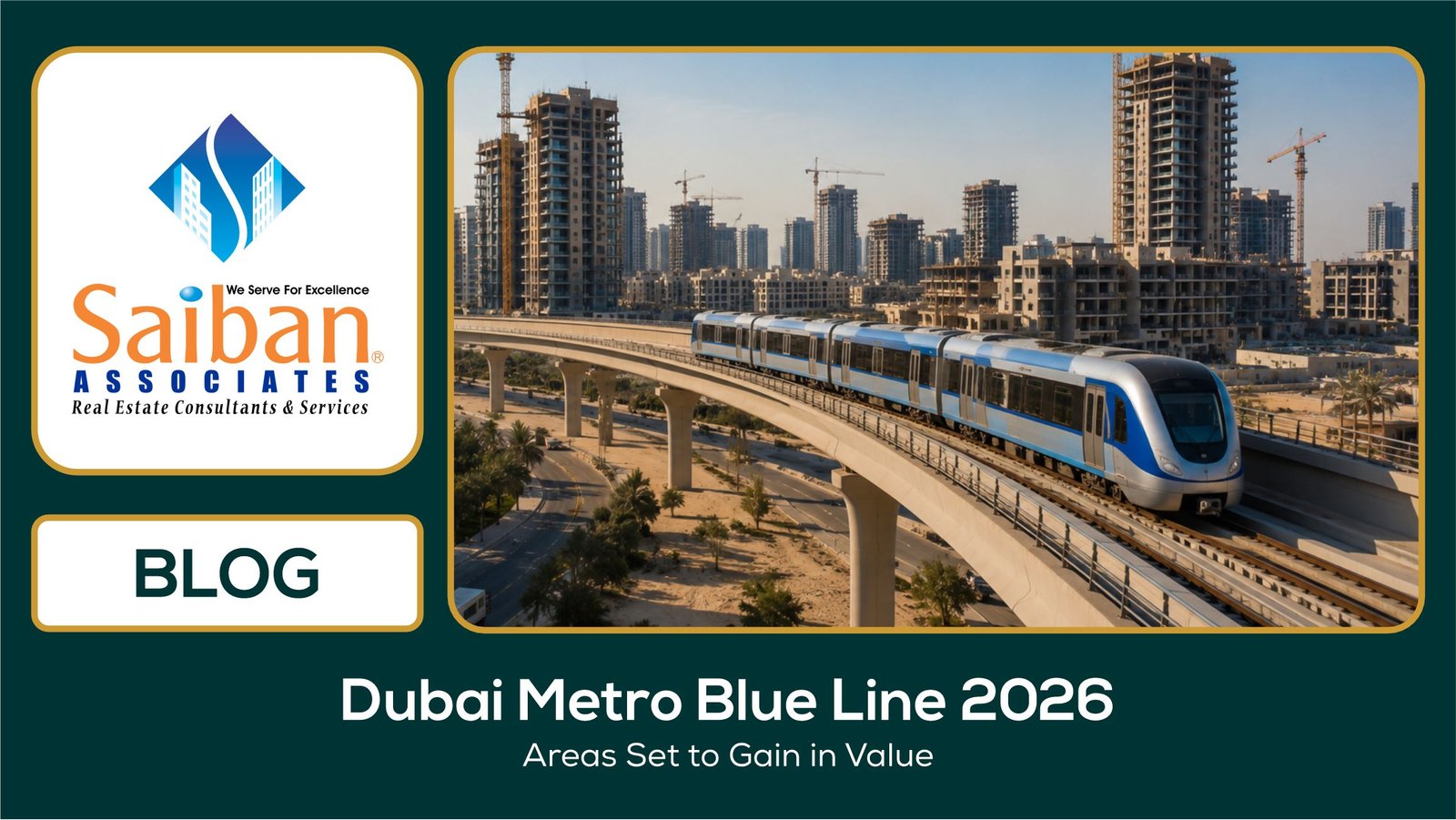
In Dubai, a new metro line has a habit of quietly rewriting the map of what a location is worth. It happened along the Red and Green lines, and it's the reason connectivity has become one of the sharpest pricing signals in the city. The next chapter is the Blue Line, now under construction and targeted to open on 9 September 2029. That date matters for investors in a specific way: the line is years from carrying passengers, which means the areas it will serve are being repriced now, before the trains run. This is the window where forward-looking buyers pay attention, and where the hype also needs a cold, honest look. Here's the investor's map for 2026.
What the Blue Line actually is
The Blue Line is the third major line in Dubai's metro network, a roughly 30 kilometre route with 14 stations, split between underground and elevated sections, and built at a project value north of AED 20.5 billion. It's designed to knit the network together rather than run off on its own: it will interchange with the Green Line at Creek and with the Red Line at Centrepoint, turning two separate lines into a connected three-line system, with another major junction planned at International City. Officials expect it to serve up to around a million residents and take a meaningful bite, roughly a fifth, out of road congestion on the corridors it touches.
A couple of the details are genuinely eye-catching. The station at Dubai Creek Harbour is set to be the tallest metro station in the world, and the line includes a dedicated rail bridge across Dubai Creek, a first for this part of the city. But for an investor, the headline is simpler: large parts of eastern Dubai that have never had rail are about to get it.
The areas set to gain
The districts most talked about in connection with the Blue Line are the ones along its eastern corridor, places that today rely almost entirely on cars. Dubai Creek Harbour sits at the marquee end, already a growth story and now with a flagship station. Further along, established but rail-less communities like International City, Dubai Silicon Oasis, Dubai International Academic City, Ras Al Khor, Mirdif, and Nad Al Sheba are the ones whose daily commute could change the most, which is usually where the sharpest repricing happens. The line is also set to improve airport access for a cluster of neighbourhoods, and better access to Dubai International is no small thing for both tenants and owners.
One honest caveat before you circle a district on a map. Not every official station name and exact placement has been finalised, and being "in" one of these areas is not the same as being a short walk from a confirmed station. The value uplift from a metro clusters tightly around the stations themselves, so the real question is always distance to the platform, not distance to the neighbourhood. Confirm the exact station location against RTA information before you assume a specific building benefits.
How much does a metro station actually add?
This is where investors need to separate pattern from promise. Looking back at the Red and Green line launches, property within roughly 500 metres of a station tended to see values rise by something in the region of 15 to 25 percent over time. That's a real and repeatable pattern, and it's the core of the Blue Line investment case. But treat it as history, not a guarantee. It's an approximate range drawn from past lines, the uplift concentrates very close to stations rather than spreading across a whole district, and it plays out over years, not months. Anyone quoting you a precise number as a certainty is selling, not analysing.
The risks the excitement tends to skip
Buying ahead of infrastructure is a legitimate strategy, but it carries risks that the marketing rarely mentions. The first is timing: with an opening targeted for 2029, your capital is committed for years before the catalyst actually arrives, and megaprojects can slip. The second is that some of the uplift may already be priced in. Once a line is announced and under construction, sellers and developers know the story too, so part of the future benefit can already sit in today's asking price, which thins out your margin. The third is disruption. Living or renting next to active metro construction is not always pleasant, and it can soften rents in the interim. And the fourth is the classic mistake of overpaying for "future connectivity" on a unit that turns out to be a fifteen-minute drive from the nearest station rather than a five-minute walk.
None of this argues against buying near the Blue Line. It argues for buying with your eyes open, on numbers rather than on a rendered map of a line that isn't running yet.
How to play it as an investor
The sensible approach is to treat the Blue Line as one factor that strengthens an already-good buy, not as the entire reason to buy. Start with a property that makes sense on today's fundamentals, its price, its rental demand, its developer, and let the future station be the upside rather than the whole thesis. Verify the exact distance to a confirmed station. Run the same conservative cash-flow test you'd run on any purchase, and check whether the current price already reflects the metro premium by comparing it against similar units further from the line. If you're buying off-plan near the corridor, vetting the developer matters even more, because you're stacking construction risk on top of infrastructure timing. Our guide on how to vet a Dubai off-plan developer covers exactly those checks, and our Dubai rental yields by area guide helps you sanity-check the income side.
Connectivity is only going to matter more, not less. Beyond the Blue Line, Dubai has approved a further underground line and is expanding intercity rail, so the whole city is being rewired around public transport. That broader shift is worth factoring into any long-term Dubai purchase. If you're weighing a new-build in Dubai's eastern growth belt, SAMANA Greenfield 2 in Dubai Land is one such option, though as always, confirm the exact station proximity before you price in any metro benefit. And if you're comparing an infrastructure-led area against an established one, our Dubai Islands vs Dubai Marina comparison applies the same growth-versus-proven thinking.
The Blue Line is a genuine, city-shaping project, and the areas it touches will likely be judged differently once the trains run. Just remember you're buying in 2026 for a benefit that lands in 2029, so let the numbers, not the map, lead. If you want a straight read on whether a specific unit near the corridor is priced fairly, the team at Saiban Associates works with international investors on exactly that call.
Contact Saiban Associates:
- UAE: +971 55 967 5717
- Pakistan: +92 306 1000100
- Email: info@saiban.pk